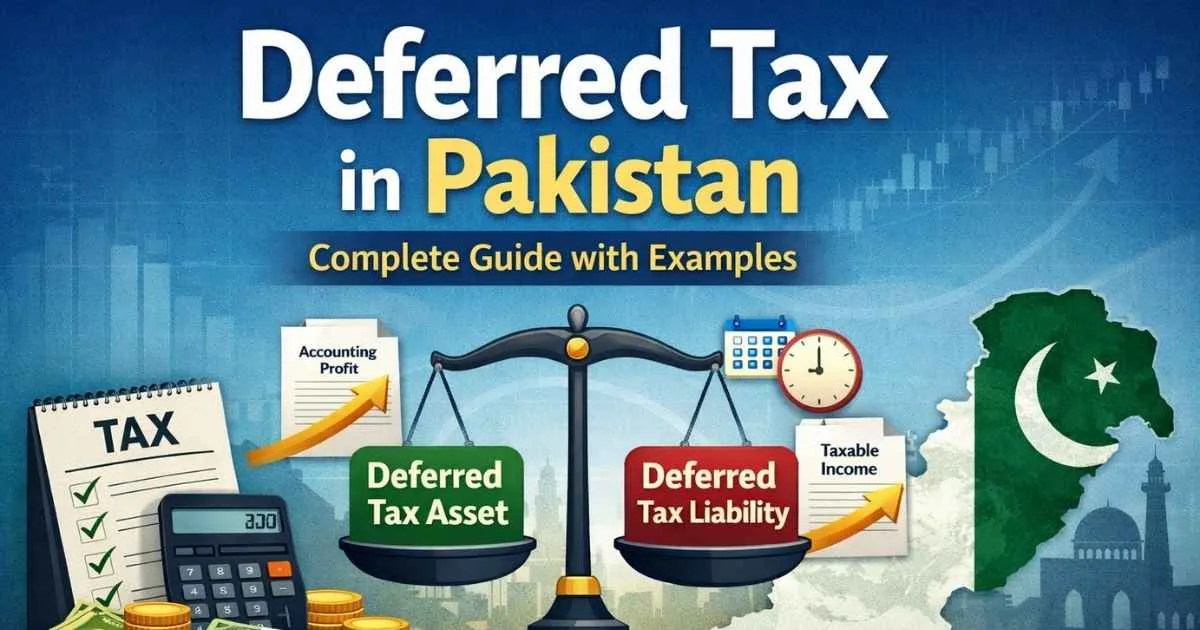
Deferred Tax in Pakistan – Complete Guide
Deferred tax is an accounting concept that arises when there is a difference between a company’s accounting profit and its taxable income. These differences occur because financial reporting rules and tax laws are not always the same.
In simple terms, deferred tax represents a tax amount that is not paid today but will be paid or adjusted in the future. It ensures that tax expenses are recorded in the same period as the related income, following the matching principle in accounting.
Why Deferred Tax is Important in Pakistan
In Pakistan, companies are required to prepare financial statements according to accounting standards while also complying with tax regulations set by the Federal Board of Revenue. Because these two systems follow different rules, differences naturally arise.
Deferred tax plays an important role because it:
- Reflects the future tax impact of current transactions
- Improves the accuracy of financial statements
- Helps businesses understand their real tax position
Without deferred tax, financial reports may present a misleading picture of a company’s profitability.
Types of Deferred Tax
Deferred tax is mainly divided into two categories:
Deferred Tax Asset (DTA)
A Deferred Tax Asset arises when a company has paid more tax than required or will receive tax benefits in the future. This usually happens when expenses are recognized earlier in accounting but later for tax purposes.
For example, if a company incurs a loss, it can carry that loss forward to reduce future taxable income. This creates a deferred tax asset.
Deferred Tax Liability (DTL)
A Deferred Tax Liability occurs when a company has paid less tax today but will have to pay more in the future. This typically happens when income is recognized earlier for accounting purposes but later for tax purposes.
A common example in Pakistan is the difference in depreciation methods used in accounting and tax calculations.
Deferred Tax vs Current Tax
Deferred tax is often confused with current tax, but both are different concepts.
| Feature | Deferred Tax | Current Tax |
| Nature | Future tax adjustment | Current year tax |
| Timing | Paid or adjusted later | Paid immediately |
| Basis | Temporary differences | Taxable income |
| Purpose | Matching income and expense | Legal tax obligation |
What Causes Deferred Tax?
Deferred tax arises due to temporary differences, which are differences between the carrying amount of assets or liabilities in financial statements and their tax base.
Temporary vs Permanent Differences
- Temporary differences reverse over time and create deferred tax
- Permanent differences never reverse and do not create deferred tax
Common Causes in Pakistan
Some common reasons for deferred tax in Pakistan include:
- Different depreciation methods for accounting and tax
- Timing differences in recognizing income or expenses
- Disallowed expenses under tax laws
How to Calculate Deferred Tax
Deferred tax is calculated using a simple formula:
Deferred Tax = Temporary Difference × Applicable Tax Rate
Step-by-step approach:
- Calculate accounting profit
- Calculate taxable income
- Identify the difference
- Apply the relevant tax rate
- Determine whether it is an asset or liability
Deferred Tax Example in Pakistan
Let’s understand this with a simple example:
A company reports:
- Accounting Profit: PKR 1,000,000
- Taxable Income: PKR 800,000
- Difference: PKR 200,000
- Tax Rate: 29%
Deferred Tax = 200,000 × 29% = PKR 58,000
Since the company is paying less tax now, this amount will be treated as a Deferred Tax Liability.
Deferred Tax and IAS 12
Deferred tax is governed by the international accounting standard
IAS 12 Income Taxes.
This standard provides guidelines on:
- Recognition of deferred tax assets and liabilities
- Measurement based on future tax rates
- Treatment of temporary differences
In Pakistan, most companies follow IAS 12 while preparing financial statements.
Deferred Tax in Financial Statements
Deferred tax affects both the balance sheet and income statement.
- In the balance sheet, deferred tax appears as a non-current asset or liability
- In the income statement, it is included as part of tax expense
This ensures that financial statements present a complete and accurate tax position.
Common Mistakes in Deferred Tax
Many students and professionals struggle with deferred tax due to common errors such as:
- Confusing deferred tax assets with liabilities
- Using incorrect tax rates
- Treating permanent differences as temporary
- Ignoring future tax implications
Avoiding these mistakes is essential for accurate financial reporting.
Conclusion
Deferred tax is a crucial concept in accounting and taxation in Pakistan. It arises due to differences between accounting rules and tax laws and helps present a more accurate financial picture of a business.
Understanding deferred tax is important not only for students and accountants but also for business owners who want to make informed financial decisions. By properly recognizing deferred tax assets and liabilities, companies can ensure compliance and improve the reliability