Withholding Tax in Pakistan: Complete Income Tax Guide (2026)
In Pakistan, withholding tax applies under the Income Tax Ordinance, and different sections cover different types of income, services, payments, and transactions. It is important to understand these sections because they explain why a specific tax amount was deducted.
Since this tax is paid before filing the annual return, the final annual tax adjustment is calculated during your tax return filing process. Whether you are a salary earner, business owner, investor, or non-resident, this complete guide will help you understand every detail so that you can make smart financial decisions in the current tax year.
What is Withholding Tax in Pakistan?
Withholding tax is a form of advance tax that is collected directly at the time of payment. This means the tax is deducted before the income reaches you. For example, banks deduct tax on profit, employers deduct tax from your salary, and companies deduct tax when they pay contractors or service providers. This system ensures smooth revenue collection and reduces the chances of tax evasion.
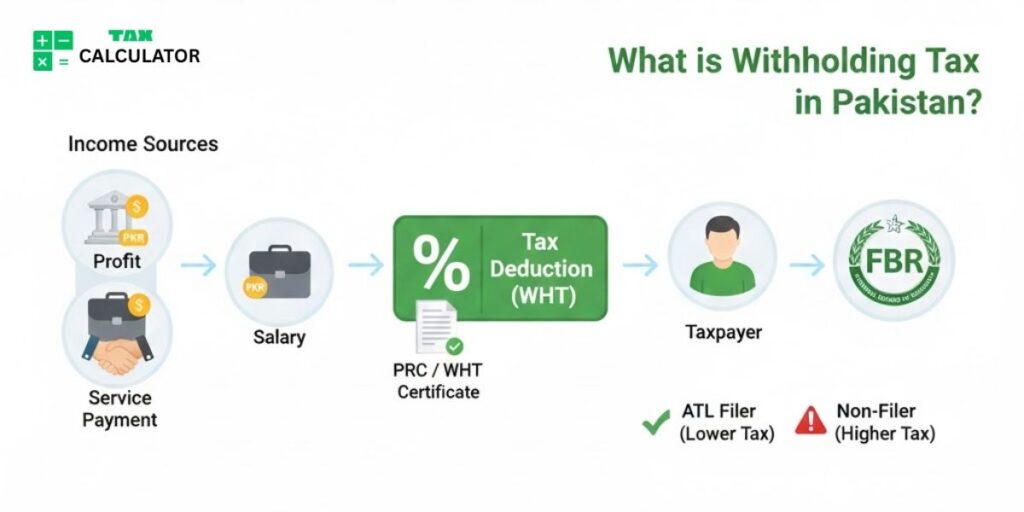
The concept of income source tax is simple: whoever makes a payment becomes a withholding agent, and whoever receives the payment is the taxpayer. When a company or employer deducts tax, the taxpayer gets a PRC (Proof of WHT deduction), which helps during the tax filing process in Pakistan.
This makes it easier for taxpayers to claim withheld tax, especially if they are part of the Active Taxpayers List (ATL) where they receive lower WHT rates compared to non-filers. For this reason, the difference between filer vs non-filer has become extremely important in Pakistan’s taxation system.
How Withholding Tax Works in Pakistan
The system of withholding tax is based on automatic deduction. For example, when an employer pays a salary, the amount is reduced according to the rules of salary withholding. Similarly, when a bank pays interest on a savings account, the deduction is made under Section 151 profit on debt. Each type of withholding follows its own rules and conditions, which ensure fairness in the Pakistan tax system.
Throughout the year, these payments are recorded and later matched with your final tax liability. If your total deductions are more than your tax requirement, you can apply for a WHT refund process.
If the deductions are less, you pay the remaining amount during the annual tax adjustment. This keeps your record clean and helps you avoid WHT penalties, especially for businesses that must submit monthly withholding statement records. Proper record keeping for taxes is essential because every taxpayer must prove that taxes were deducted at the correct time.
Types of Withholding Taxes in Pakistan
There are many types of withholding tax applied under the Income tax ordinance, and each one is designed to collect goods and services tax deduction, salary-based tax, investment taxes, or taxes on specific transactions. Understanding these categories helps you understand where your money is going.
One of the most common types is salary-based employee withholding tax, which is deducted under Section 149 of Pakistan. Another important category is banking-based tax, such as bank profit tax, interest income withholding, and bank withholding (cash withdrawal).
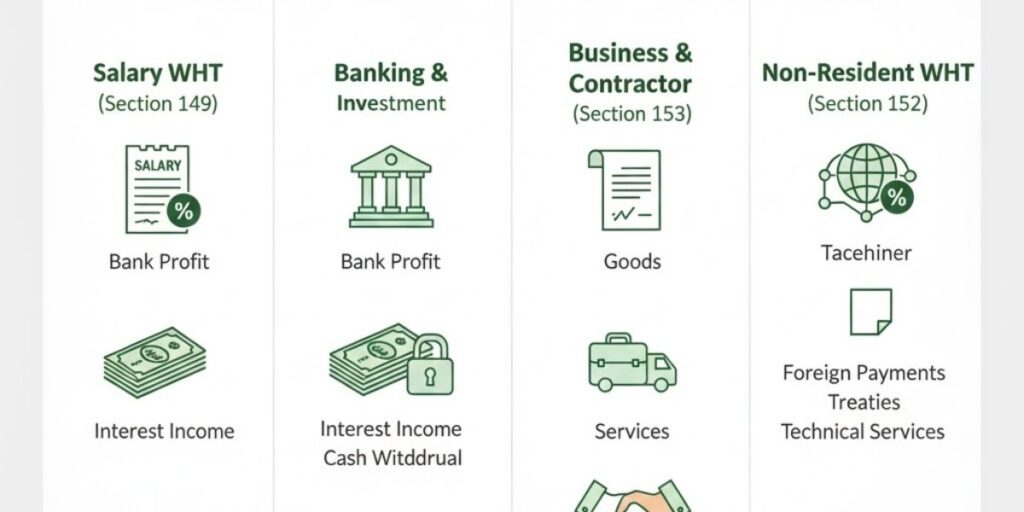
There are also taxes related to business operations, such as services withholding tax, goods withholding tax, and contractor WHT Pakistan, which fall under Section 153 of Pakistan. Individuals who are not residents of Pakistan fall under non-resident tax, where payments are taxed under Section 152 of the Pakistan Income Tax Ordinance, especially under agreements related to double taxation treaties with Pakistan.
Benefits of Withholding Tax in Pakistan
One major benefit of withholding tax is that it creates a smooth system of tax compliance in the country. When payments are deducted at the source, it prevents tax fraud and improves government revenue management.
It also reduces the pressure of paying a large amount at the end of the year because taxpayers have already paid through monthly tax deductions throughout the year.
Another advantage is that taxpayers who stay compliant and remain on the Active Taxpayers List (ATL) enjoy reduced WHT rates. They also receive different types of tax credit and can easily apply for a tax exemption certificate or reduced rate certificate if eligible.
Most importantly, at the end of the tax year, taxpayers can file a tax return filing and request a tax refund if extra deductions were made. This process allows better financial planning and transparency, which benefits both individuals and companies.
Withholding Tax on Salary (Section 149, Pakistan)
Salary earners in Pakistan fall under a well-defined tax structure where tax is deducted through employer tax deduction under Section 149 of the Pakistan. The employer becomes a withholding agent and must calculate the correct salary tax according to the tax slabs. Once the tax is deducted, it appears in the employee’s tax profile and contributes to the final annual tax adjustment.
| Annual Taxable Income (PKR) | Tax Rate |
| Up to 600,000 | 0% |
| 600,001 – 1,200,000 | 5% of the amount exceeding 600,000 |
| 1,200,001 – 2,200,000 | 30,000 + 15% of the amount exceeding 1,200,000 |
| 2,200,001 – 3,200,000 | 180,000 + 25% of the amount exceeding 2,200,000 |
| 3,200,001 – 4,100,000 | 430,000 + 30% of the amount exceeding 3,200,000 |
| Above 4,100,000 | 700,000 + 35% of the amount exceeding 4,100,000 |
This system ensures that employee withholding tax is fully accounted for throughout the year. By the time a person files their tax return, most of their liability is already covered. The deduction also depends on whether the employee is a filer or a non-filer. Since filer vs non-filer rates differ, it is always better to remain a filer to reduce your salary-based tax burden. Employers must deposit the deducted tax through FBR challan payment before the WHT deposit deadline to avoid penalties.
Withholding Tax on Banking & Investments (Sections 150 & 151)
Most people in Pakistan pay withholding tax without realizing it whenever they earn profit from a bank account, mutual fund, or investment scheme. Under Section 151 profit on debt, banks deduct profit on debt tax on the amount of profit earned. This includes profits from savings accounts, term deposits, certificates, and similar financial instruments. The deduction is higher for non-filers, which again highlights the importance of being on the Active Taxpayers List (ATL).
Similarly, companies deduct dividend tax under the Dividend tax rates (Section 150) when they distribute profit to shareholders. This also falls under income source tax and is part of the taxpayer’s annual profile. Another type is interest income withholding, which applies to different fixed-income investments. The taxpayer can later review all these deductions during the tax filing process in Pakistan and claim any excess amount through the WHT refund process.
Withholding Tax for Non-Residents (Section 152 Pakistan)
Individuals or companies who are not residents of Pakistan fall under non-resident tax deduction Pakistan, which operates under Section 152 Pakistan. This includes payments made for services, contracts, technical assistance, or royalties. A common example is when Pakistani companies hire foreign consultants; the tax is deducted before sending payments abroad. This deduction ensures transparency and fairness in cross-border transactions.
| Recipient (1, 2, 3) | WHT (%) | ||
| Dividends | Interest | Royalties | |
| Non-resident individuals | |||
| Non-treaty | 15 | 10 | 15 |
| Treaty | (4) | (4) | (4) |
| Non-resident corporations | |||
| Non-treaty | 15 | 10 | 15 |
| Treaty: | (4, 5) | (4, 6) | (4) |
Many countries have agreements with Pakistan under double taxation treaties, which provide protection from paying tax twice—once in Pakistan and once in their home country. However, deductions still apply at the source unless a tax exemption certificate or reduced rate certificate is provided. In many cases, taxes are also applied on technical services fee tax, which is very common in the IT, telecom, and engineering sectors.
Withholding Tax on Business & Services (Section 153 Pakistan)
Business activities in Pakistan fall under a detailed system of deductions under Section 153 Pakistan. Whenever payments are made for goods, services, or contracts, the payer deducts goods withholding tax, services withholding tax, or contractor WHT Pakistan. This ensures that business owners contribute fairly to the national tax structure through advance tax collection.
| Category | Filer Rate | Non-Filer Rate |
| Company (Other Goods) | 5% | 10% |
| Company (Toll Manufacturing) | 9% | 18% |
| Individual/AOP (Other Goods) | 5.5% | 11% |
| Individual/AOP (Toll Manufacturing) | 11% | 22% |
| Sale of Rice, Cotton Seed, Edible Oils | 1.5% | 3% |
These deductions affect the final tax liability during tax return filing. Businesses must also maintain complete documentation and submit WHT statements filing every month. If the business fails to deposit deductions in time, WHT penalties are applied. Many businesses also apply for WHT exemption for companies or reduced rates depending on their turnover and compliance level. Proper record-keeping for taxes is extremely important for avoiding legal and financial issues.
Daily Life Withholding Taxes in Pakistan
People pay withholding tax in many everyday transactions, often without realizing it. For example, banks deduct cash withdrawal tax (Section 231A) when non-filers withdraw large amounts. Similarly, vehicles purchased or transferred involve car registration tax (231B), which increases for non-filers. Prize bond winners must pay prize bond tax (Section 156), and auctions include auction tax (236A). Even international payments made through cards can include credit/debit card transaction tax (236Y) for non-filers.
The table below shows common daily-life withholding taxes:
| Transaction Type | Law Section | Who Pays | Notes |
| Cash Withdrawal | 231A | Non-filers | Higher rate for non-filers |
| Car Registration | 231B | All | Paid during registration or transfer |
| Prize Bond Winning | 156 | All | Tax deducted at the time of prize |
| Auction Purchase | 236A | All | Deducted on auctioned items |
| Debit/Credit Card Foreign Spend | 236Y | Non-filers | Applies only to non-filers |
These deductions affect your financial planning and must be checked regularly to ensure they are correctly added to your tax profile.
How to Check Withholding Tax Online
Taxpayers can review all their deductions online through the FBR Pakistan portal. The system allows individuals and businesses to check all forms of tax deducted at source. This includes salary, banking, business, and daily-life deductions. The process is simple and requires login credentials or mobile verification. Once logged in, you can download PRCs, check statements, and verify whether your employer or bank has deposited the amount properly.
This system is extremely helpful during your tax filing process in Pakistan because it allows you to match each amount before submitting your return. Any missing data can be corrected by contacting the deducting entity. This ensures the correct calculation of your liability and helps you avoid errors in your annual return.
Withholding Tax Compliance & Statements
Businesses in Pakistan must follow strict rules for WHT statement filing. Every month, companies must upload details of all tax deductions, pay using FBR challan payment, and ensure they meet the WHT deposit deadline. Failure to follow these steps results in fines and legal action under the Income Tax Ordinance. Therefore, companies must have proper accounting systems to avoid WHT penalties and manage deductions smoothly.
Good record-keeping for taxes protects businesses during audits and helps maintain a clean tax profile. Companies that remain compliant enjoy benefits such as reduced deduction rates, eligibility for certificates, and smoother business operations. This system also ensures reliability in the overall economy and reduces the risks of tax-related disputes.
Withholding Tax Refund & Exemptions
Many taxpayers qualify for a WHT refund process because extra money was deducted throughout the year. Once you file your return, the FBR reviews your account and issues refunds if applicable. To receive your money back, it is important to attach a valid PRC (Proof of WHT deduction) and bank statements. Being part of the Active Taxpayers List (ATL) increases your chances of a smooth refund experience.
Some taxpayers can apply for WHT exemption for companies or reduced deduction rates, especially exporters, nonprofit organizations, or businesses under specific laws. A reduced rate certificate helps companies lower their tax burden during the year. Individuals can also claim withheld tax during the annual tax filing and apply for a tax refund if their total deductions exceed their actual liability.
Conclusion
Understanding withholding tax in Pakistan is essential for smart financial decisions, whether you are a salaried employee, investor, business owner, or non-resident. The system of tax deduction, advance tax, and tax deducted at source helps the government manage revenue while allowing taxpayers to monitor their deductions through proper tools and records.
Being part of the Active Taxpayers List (ATL) and maintaining correct documentation ensures lower WHT rates, fewer penalties, and better financial stability. When taxpayers stay compliant with the Pakistan tax system and follow the rules of the Income Tax Ordinance, they enjoy smooth refunds, reduced rates, and long-term benefits.