Types of Taxes in Pakistan – Complete Guide (2026)
Understanding the types of taxes in Pakistan is no longer optional. Whether you are a salaried employee, a freelancer, a business owner, or an investor, taxes directly affect your income, savings, pricing, and long‑term financial planning. Every year, changes through the Finance Act 2025–26, FBR notifications, and provincial laws reshape the Pakistan tax system, making it important to stay informed.
This comprehensive Pakistan tax guide explains all major direct taxes in Pakistan, indirect taxes in Pakistan, federal, provincial, and local taxes in simple English. The goal is clarity: you should know what tax applies, who pays it, how it is calculated, and how to stay compliant—without confusion or legal risk.
Overview of Pakistan’s Tax System
Taxes in Pakistan are collected at three different levels: Federal, Provincial, and Local. Each level has its own authority, laws, and scope of taxation.
Three Tiers of Tax Collection
- Federal Level
The Federal Board of Revenue (FBR) administers most federal taxes in Pakistan, including income tax, sales tax on goods, customs duties, and federal excise duty. - Provincial Level
Provinces collect taxes on services, professions, and certain properties through their respective authorities:- Sindh Revenue Board (SRB)
- Punjab Revenue Authority (PRA)
- Khyber Pakhtunkhwa Revenue Authority (KPRA)
- Balochistan Revenue Authority (BRA)
- Local / Municipal Level
Local governments collect municipal taxes, property‑related charges, water taxes, and local business levies to fund community services.
Together, these layers define tax compliance in Pakistan for individuals and businesses.
Classification of Taxes in Pakistan
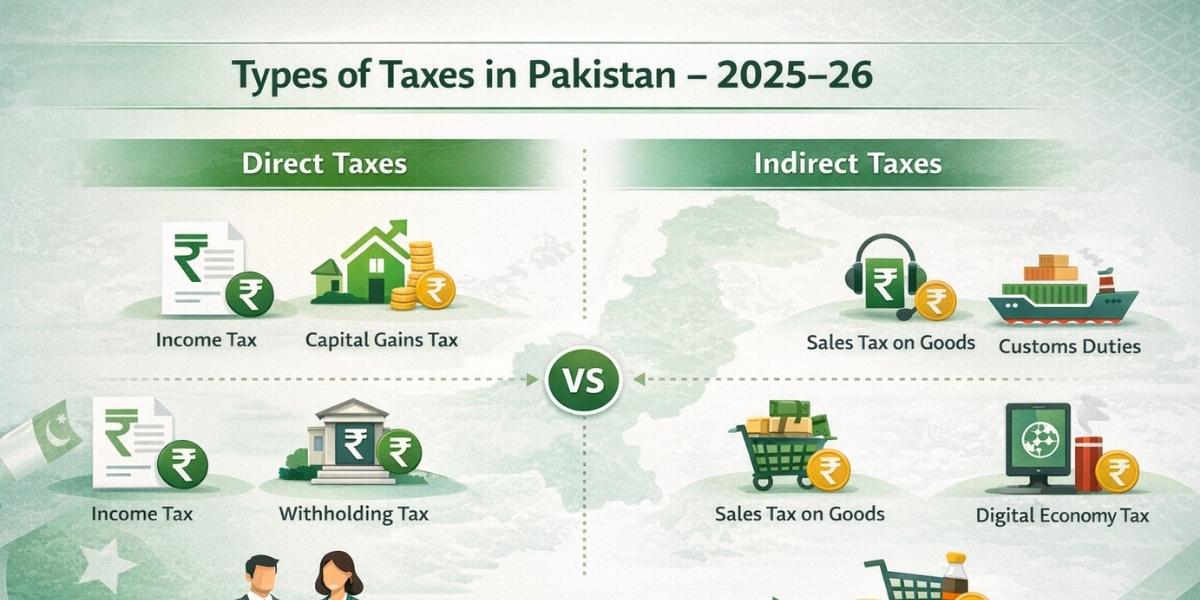
Broadly, taxes are divided into direct taxes and indirect taxes.
Direct Taxes vs Indirect Taxes
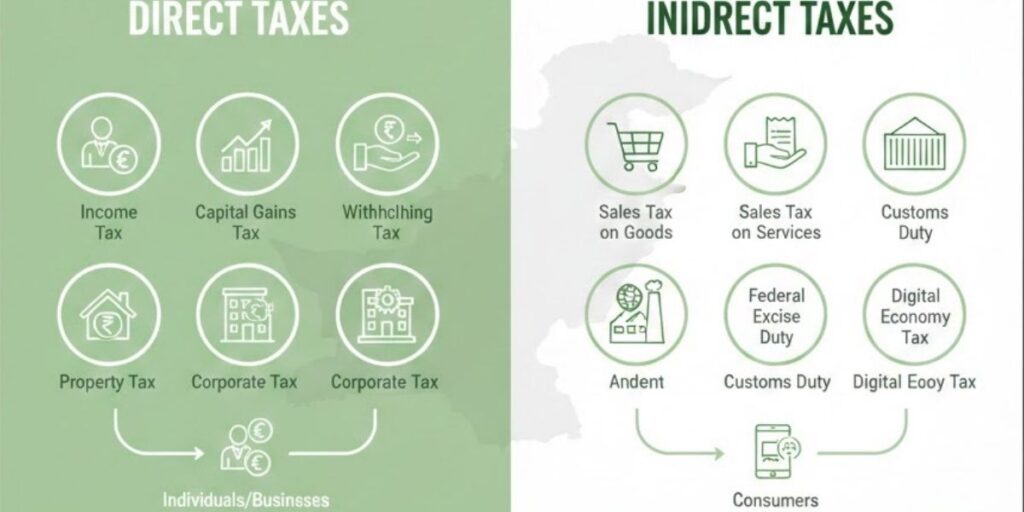
- Direct taxes in Pakistan are paid directly by the person or entity earning income. The burden cannot be shifted.
- Indirect taxes in Pakistan are collected through goods and services, and the burden is usually passed on to the final consumer.
This distinction is central to understanding your real tax burden.
Direct Taxes in Pakistan
Direct taxes are mainly governed by the Income Tax Ordinance and administered by the Federal Board of Revenue (FBR).
Income Tax in Pakistan
Income tax in Pakistan is the most important and widely applicable tax. It is charged on income earned by individuals, associations of persons (AOPs), and companies.
Taxpayer Categories in Pakistan
Different taxpayer categories Pakistan face different rules:
- Salaried individuals’ tax: Income from employment, plus any other income.
- Non‑salaried / self‑employed tax: Business owners, professionals, consultants.
- Freelancers’ tax in Pakistan: Treated as business income, often with special regimes for IT and exports.
- Companies: Subject to corporate tax in Pakistan on profits.
Sources of Taxable Income
Income tax is not limited to salary. Common sources include:
- Business income tax
- Rental income tax Pakistan
- Tax on dividends and interest
- Capital gains
- Other income from various sources
Each source has its own rules for deductions, withholding, and exemptions.
Income Tax Slabs & Rates (2025–26)
The tax slabs Pakistan follow a progressive structure. Under tax rates Pakistan 2025–26, income up to PKR 600,000 is exempt for salaried individuals. Higher income brackets are taxed at increasing rates.
High‑income earners may also face a surcharge on high income, while certain companies are subject to super tax Pakistan.
Minimum, Advance & Alternate Corporate Tax
- Advance tax deduction ensures tax collection during the year.
- Minimum tax on turnover may apply even if a business reports losses.
- The alternate corporate tax restricts excessive deductions for companies.
These mechanisms reduce evasion and stabilize revenue.
Capital Gains Tax (CGT)
Capital gains tax in Pakistan applies when you sell an asset for a profit.
Assets Subject to CGT
- Listed shares and securities
- Mutual funds
- Immovable property (land and buildings)
Rates depend on the holding period. Longer holding periods often enjoy reduced rates or exemptions, especially for property.
Withholding Tax in Pakistan
Withholding tax Pakistan is collected at source, before making any payments making it one of the most effective compliance tools.
Common Withholding Transactions
- Salaries
- Bank profit and interest
- Dividends
- Payments to contractors and service providers
- Rent and lease payments
- Imports and exports
Filer vs Non‑Filer Tax Rates
The difference between filer vs non‑filer tax rates is significant. Non‑filers face higher deductions, restricted transactions, and reputational issues.
Adjustable vs Final Withholding Tax
- Adjustable tax is credited against final liability.
- Final tax settles the tax obligation permanently.
Understanding this distinction helps manage cash flow.
Other Direct Taxes
- Property tax Pakistan and capital value tax (mainly provincial/municipal)
- Professional tax Pakistan imposed by provinces
- Special asset‑based or sector‑specific corporate taxes
Indirect Taxes in Pakistan
Indirect taxes are embedded in prices and paid by consumers, even if collected by businesses.
Sales Tax in Pakistan (GST / VAT System)
Sales Tax on Goods (Federal)
- Standard GST rate: 18%
- Higher rate (up to 25%) on selected goods
- Imports attract GST along with customs duty
This system closely resembles a VAT system Pakistan.
Sales Tax on Services (Provincial)
- Sindh sales tax on services (SRB)
- Punjab sales tax on services (PRA)
- KPRA sales tax and BRA sales tax
Rates usually range between 15% and 16%, depending on service type.
Input Tax Adjustment
Registered businesses can offset input tax adjustment against output tax liability, reducing overall tax cost.
Customs Duties & Import Taxes
When goods enter Pakistan, several taxes may apply:
- Customs duty Pakistan
- Import duties Pakistan
- Regulatory duty
- Additional customs duty
Goods are classified using HS codes Pakistan, which determine applicable rates.
Federal Excise Duty (FED)
Federal excise duty (FED) applies to specific goods and services, such as:
- Excise tax on cigarettes
- Excise duty on beverages
- Luxury goods tax
FED is separate from sales tax and often sector‑specific.
Digital Economy & Modern Taxes
As the online business grows, digital economy tax Pakistan has become a key focus.
- Digital presence proceeds tax under the DPPT Act 2025 (currently suspended)
- E‑commerce tax Pakistan on online marketplaces
- Withholding tax on digital services
- GST on digital goods
- Payment gateway tax Pakistan
- IT services tax Pakistan under special regimes
This area evolves rapidly and requires close monitoring.
Provincial & Local Taxes in Pakistan
Beyond federal taxes, provincial taxes in Pakistan play a major role.
- Sales tax on services
- Professional tax
- Property valuation tax
- Local government taxes and municipal charges
Ignoring provincial compliance can lead to operational issues.
Special Tax Regimes, Incentives & Reliefs
Governments use incentives to promote growth:
- SME and small business regimes
- Export incentives
- IT and freelancer concessions
- Special Economic Zones (SEZs) tax holidays
- Relief under Double Taxation Agreements (DTAs) for foreign income
These provisions can significantly reduce tax liability if used correctly.
Tax Compliance in Pakistan
Understanding taxes is incomplete without compliance.
Registration & Filing
- NTN registration Pakistan
- Sales tax registration Pakistan
- Filing through the IRIS portal FBR
Record Keeping & Audits
Proper record keeping for taxes, timely filing, and correct documentation help avoid tax audits Pakistan.
Penalties & Non‑Filer Consequences
Late filing leads to tax penalties and interest, while non‑filers face higher rates and transaction restrictions.
Recent Changes Under Finance Act 2025–26
Key highlights include:
- Relief for salaried individuals
- Changes in withholding tax rates
- Higher tax on cash withdrawals by non‑filers
- Property‑related tax relief measures
Frequently Asked Questions
How much tax do I pay?
Your liability depends on income type, slab, and filer status. You can calculate tax online Pakistan using a Pakistan tax calculator.
Do freelancers pay tax in Pakistan?
Yes, freelancers are taxed on business income, often under special regimes.
Conclusion
Understanding the types of taxes in Pakistan empowers you to make informed financial decisions. Tax laws evolve every year, but with the right knowledge, you can stay compliant, reduce risk, and legally optimize your tax burden.
If you are unsure about your situation, seek expert tax help Pakistan, use reliable tools to check tax slab Pakistan, and follow official guidance. Smart tax planning today can save money tomorrow.