
Advantages of Outsourcing Internal Audits
Running a business in Pakistan today is more challenging than ever. Whether you manage a small company, a growing startup, or a large organization, you must maintain strong financial controls, ensure compliance, and manage risk effectively. This is where the role of an internal audit becomes extremely important. An internal audit ensures that your financial systems, operations, and control mechanisms are working correctly and that your company is protected against errors, fraud, and regulatory issues.
However, not every business has the resources to build a full internal audit department. Hiring qualified auditors, training them, buying audit tools, and staying updated with regulatory changes require time, investment, and expertise. Because of these challenges, many organizations in Pakistan and around the world now prefer to outsource internal audit services to professional firms.
What Is Outsourcing Internal Audit?
Outsourcing internal audit refers to the practice of assigning your company’s internal auditing tasks to an independent, specialized firm instead of performing these tasks in-house. These external professionals examine your systems, evaluate risks, review financial controls, identify weaknesses, and help you improve operational efficiency.
You maintain control over your business, but the technical and analytical part of the audit is completed by experts who have a broader industry perspective. To understand the basic concept of internal audit, you may refer to this overview:
🔗 https://en.wikipedia.org/wiki/Internal_audit
This professional support allows your organization to stay compliant, identify problems early, and make informed decisions without the pressure of maintaining a large audit department internally.
Advantages of Outsourcing Internal Audit
Outsourcing internal audit has become one of the smartest decisions companies can make today. It provides access to expertise, reduces cost, increases transparency, and helps build a stronger financial structure. Below are the 10 major advantages explained , especially for Pakistani businesses.
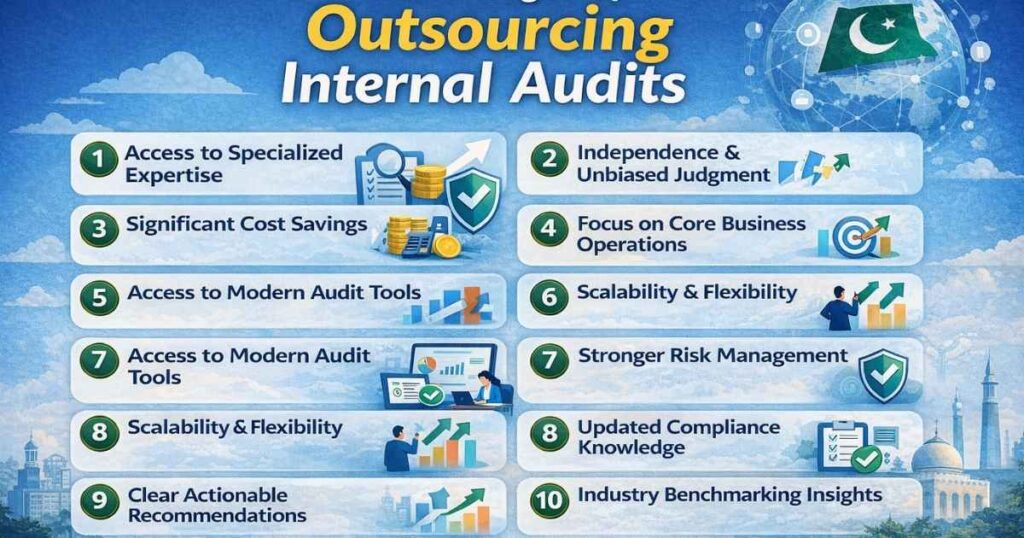
1. Access to Specialized Expertise
One of the biggest advantages of outsourcing internal audit is gaining instant access to highly skilled auditors who have years of experience in risk assessment, financial reporting, compliance, and process evaluation. These firms work with multiple industries, which means they understand best practices better than most in-house teams.
Internal audit firms usually hire:
- Chartered accountants
- Certified internal auditors (CIA)
- Risk management experts
- IT audit professionals
- SOX compliance consultants
Because laws and regulations change frequently — especially tax laws and corporate compliance requirements — outsourced teams stay updated through constant training and certifications. You don’t have to invest in training your staff. Instead, you get experts who already know the latest regulatory standards, including frameworks like SOX.
2. Independence and Unbiased Judgment
An internal employee may sometimes hesitate to highlight issues due to internal pressure, personal relationships, or office politics. However, an independent external auditor does not face these constraints. Their only objective is to deliver a factual, transparent assessment of your business operations.
External auditors are not influenced by internal dynamics, so they can detect gaps, fraud risks, weak controls, and operational inefficiencies without hesitation. Investors, shareholders, and regulators also trust independent reports more because they reflect an unbiased opinion.
Understanding auditor independence can be explored further here:
🔗 https://en.wikipedia.org/wiki/Auditor_independence
This independence builds credibility for your company and strengthens stakeholder confidence.
3. Significant Cost Savings for Your Business
Maintaining a full internal audit department involves multiple expenses: salaries, benefits, office space, software, training, compliance tools, and ongoing professional development. For most SMEs in Pakistan, these costs are heavy and often unnecessary.
Outsourcing transforms these fixed costs into variable costs. You only pay for the services you use — without the burden of full-time staffing. You don’t have to hire new employees, bear training costs, or spend on advanced audit software.
Outsourcing is far more cost-effective, especially for small and mid-sized businesses that need quality audits but cannot afford a large internal audit infrastructure.
4. More Focus on Core Business Operations
When businesses handle audits internally, their employees often become overburdened, dividing their attention between their daily responsibilities and the audit process. This affects performance and slows down business growth.
Outsourcing internal audit allows your team to stay focused on core functions such as strategy, operations, product development, sales, customer service, and business expansion. While professionals handle the audit tasks, your leadership can dedicate time to revenue-generating activities.
This separation of responsibilities leads to improved efficiency, better decision-making, and stronger business performance.
5. Access to Modern Audit Tools and Technology
Professional audit firms invest heavily in technology to deliver fast, accurate, and reliable results. They use advanced tools such as:
- Risk assessment software
- Data analytics systems
- AI-based auditing tools
- Fraud detection technology
- Automated audit workflows
- Cloud-based audit dashboards
Most businesses in Pakistan cannot afford these advanced technologies independently. Outsourcing allows you to benefit from these tools without purchasing them.
To understand the role of technology in auditing, you may refer to:
🔗 https://en.wikipedia.org/wiki/Audit_software
Technology enhances accuracy, makes reporting more transparent, and speeds up the entire audit process.
6. Scalability and Flexibility
Business needs change over time. During certain months, you may need an extensive audit. During calmer periods, you may need limited support. Outsourced internal audit offers complete scalability, allowing firms to adjust resources according to your needs.
Whether you are expanding, merging, launching new products, or facing new regulatory requirements, outsourced auditors can easily increase or decrease support without any delay.
This flexibility ensures your business never faces staff shortages or unnecessary staffing costs.
7. Stronger Risk Management and Fraud Detection
Risk management is becoming increasingly important in Pakistan due to rapid digitalization, cybersecurity threats, changing tax regulations, and financial fraud risks. Outsourced audit teams bring a deeper understanding of risks because they work across industries and stay updated with global best practices.
To better understand risk management concepts, you may review:
🔗 https://en.wikipedia.org/wiki/Risk_management
External auditors help detect:
- Fraud attempts
- Asset misuse
- Internal control weaknesses
- Policy violations
- Cybersecurity vulnerabilities
- Operational inefficiencies
This early detection protects your business from financial losses, legal issues, and reputational damage.
8. Updated Knowledge of Compliance and Regulations
Regulatory requirements change frequently, and non-compliance can result in penalties, fines, and legal problems. Outsourced auditors stay updated with:
- Tax laws
- Corporate governance rules
- Regulatory filing requirements
- SOX compliance
- Industry-specific standards
- Anti–money laundering (AML) guidelines
Because they work with multiple clients, their knowledge is broader and more current than in-house teams. A quick overview of corporate governance can be found here:
🔗 https://en.wikipedia.org/wiki/Corporate_governance
They ensure your business remains compliant at all times and avoid costly mistakes.
9. Clear, Practical, and Actionable Recommendations
One of the greatest advantages of outsourcing internal audit is receiving objective, practical advice for improving your systems. External auditors evaluate your operations with fresh eyes. They review data, assess risks, and then provide specific recommendations on how to improve:
- Internal processes
- Financial controls
- Fraud prevention systems
- Regulatory compliance
- Efficiency and productivity
- Data management
- Cost control mechanisms
Because they are not part of your internal team, their suggestions are fact-based and free from bias. These insights significantly improve the overall performance of your business.
10. Industry Benchmarking and Best Practices
Audit firms interact with multiple industries — banks, manufacturers, service providers, retailers, tech companies, and more. This exposure gives them a clear understanding of what practices are most effective across different sectors.
They use this experience to compare your organization’s performance with industry standards. This process, known as benchmarking, helps identify gaps and improvement areas. To understand benchmarking further:
🔗 https://en.wikipedia.org/wiki/Benchmarking
This external viewpoint ensures your company keeps up with modern practices and stays competitive in the market.
How the Outsourcing Internal Audit Process Works
Outsourcing internal audit is simple and structured. Here is a smooth, step-by-step explanation of how the process usually works:
The journey begins when the company identifies its needs — whether it requires a full internal audit, risk assessment, SOX compliance review, operational audit, or financial controls evaluation.
After defining the scope, you select a qualified audit partner with relevant expertise and industry experience. Both parties then set clear expectations regarding timelines, reporting style, and communication procedures.
Once the agreement is finalized, the audit firm collects the necessary data and documentation. They study your systems, interview staff, review policies, examine financial transactions, and evaluate internal controls.
Throughout the audit, they use modern tools to analyze data and assess risk. After completing their review, they prepare a detailed audit report containing findings, weaknesses, and improvement recommendations. Many firms also help implement these solutions to strengthen your internal controls and ensure long-term compliance.
This structured approach keeps the entire process smooth, transparent, and highly effective for your business.
Why Outsourcing Internal Audit Is Ideal for Pakistani Businesses
In Pakistan, many companies — especially SMEs — find it difficult to maintain a full internal audit department due to limited budgets, lack of skilled staff, and rapidly changing regulations. Outsourcing solves these challenges by offering affordable, expert-driven solutions without long-term commitments.
It provides a powerful combination of cost efficiency, transparency, independence, and professional expertise, all of which strengthen your business from within. In a challenging economic environment, outsourcing internal audit is one of the smartest decisions to ensure financial integrity and operational accuracy.
Disadvantages of Outsourcing Internal Audit Function
Although outsourcing internal audit offers many benefits, it is important to understand the potential disadvantages as well. This helps you make a balanced and informed decision.
1. Less Internal Control Over Day-to-Day Audit Activities
Since the audit work is not happening inside your office, some businesses may feel they have less direct control over audit activities. Regular communication and defined reporting schedules help reduce this issue.
2. Possible Confidentiality Concerns
Some companies are concerned about sharing internal financial data with an external firm. However, reputable audit firms follow strict confidentiality laws and professional ethics.
3. Risk of Misalignment With Company Culture
External auditors may not fully understand your company’s culture or operational style initially. This usually improves as the engagement continues.
4. Dependency on External Providers
Relying too heavily on outsourced auditors may reduce internal knowledge development. To overcome this, businesses often use a hybrid model—outsourcing major tasks while keeping some audit functions in-house.
Conclusion: Is Outsourcing Internal Audit Worth It?
Yes — outsourcing internal audit is absolutely worth it. It gives you access to professional auditors, reduces operational costs, strengthens compliance, and helps you identify risks before they cause damage. It allows your employees to focus on business growth while experienced auditors handle the technical, analytical, and regulatory aspects.
Most importantly, it builds confidence among investors, partners, and regulatory bodies by ensuring that your company’s financial and operational controls meet the highest standards.
If your business wants accuracy, transparency, and long-term stability, outsourcing internal audit is the right choice.